报告详情
Comparative study on the performance of ConvLSTM and ConvGRU on classification problems- taking short-duration heavy rainfall early-warning as an example
编号:114
访问权限:仅限参会人
更新:2026-07-31 21:54:15 浏览:8次
张贴报告
摘要
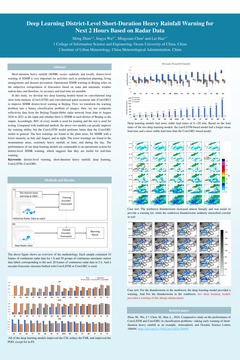
Convolutional long short-term memory (ConvLSTM) and convolutional gated recurrent unit (ConvGRU) are 2 widely adopted deep learning models that combine recurrent mechanisms with convolutional operations for spatio-temporal sequences forecasting. To clarify convergence speed and classification ability of the above 2 models, using the same model architecture to predict a same classification problem is in need. This research treats transforms the short-duration heavy rainfall (SDHR) district-level warning problem in Beijing into as a binary classification problem in deep learning, and composite radar reflectivity data of Beijing-Tianjin-Hebei radar network and rainfall data from automatic weather stations in Beijing are used for training and performance evaluation. The results show that, the convergence speed of ConvGRU is approximately 25% faster than that of ConvLSTM. The early-warning performance of ConvLSTM and ConvGRU has the similar trend with region, time, rain intensity, but most of the scores of ConvLSTM are higher, and in a few cases, ConvGRU has higher scores.
关键词
deep learning,convolutional long short-term memory,convolutional gated recurrent unit,classification
报告人

武静雅
助理研究员 北京城市气象研究院稿件作者
全部评论
重要日期
-
会议日期
08月12日
2026
至08月15日
2026
-
08月05日 2026
初稿截稿日期
-
08月12日 2026
注册截止日期
主办单位
成都信息工程大学
承办单位
成都信息工程大学
联系方式
历届会议
-
2025年08月15日 中国 大同市
第七届全国中尺度气象学研讨会 -
2021年01月14日 中国 南京市
第三届全国中尺度气象学论坛


发表评论