报告详情
Pacific Decadal Reorganization of Spring and Summer Onset El Niño Development Pathways
编号:148
访问权限:仅限参会人
更新:2026-08-07 13:51:31
浏览:9次
张贴报告
摘要
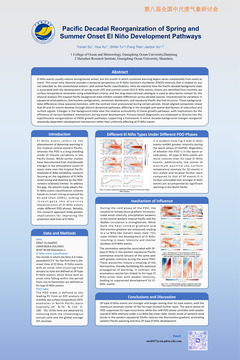
El Niño events usually mature during boreal winter, but the month in which sustained warming begins varies substantially from event to event. This onset-time diversity provides a temporal perspective on El Niño–Southern Oscillation (ENSO) diversity that is related to, but not reducible to, the conventional eastern- and central-Pacific classifications. Here we examine how the Pacific decadal background state is associated with the development of spring-onset (SP) and summer-onset (SU) El Niño events. Events are identified from monthly sea surface temperature anomalies using established criteria, and the long observational catalogue is used as descriptive context for the physical analysis.The tropical Pacific background state exhibits notable differences across decadal epochs, characterized by variations in equatorial wind patterns, thermocline configuration, convection distribution, and equatorial Pacific thermal structure. These background-state differences show seasonal evolution, with the contrast most pronounced during certain periods. Onset-aligned composites reveal that SP and SU events develop through distinct dynamical pathways, differing in the strength and spatial distribution of subsurface and surface signals. Changes in the background state alter the relative accessibility of these growth pathways, with implications for the efficiency of various feedback mechanisms during event development. Process-based diagnostics are employed to directly test the hypothesized reorganization of ENSO growth pathways, supporting a framework in which decadal background changes reorganize seasonally dependent development mechanisms rather than uniformly affecting all El Niño events.
关键词
El Niño , Pacific Decadal Oscillation, onset time,mean state
报告人

苏钰涵
学硕 广东海洋大学海洋与气象学院稿件作者
全部评论
重要日期
-
会议日期
08月12日
2026
至08月15日
2026
-
08月05日 2026
初稿截稿日期
-
08月12日 2026
注册截止日期
主办单位
成都信息工程大学
承办单位
成都信息工程大学
联系方式
历届会议
-
2025年08月15日 中国 大同市
第七届全国中尺度气象学研讨会 -
2021年01月14日 中国 南京市
第三届全国中尺度气象学论坛


发表评论